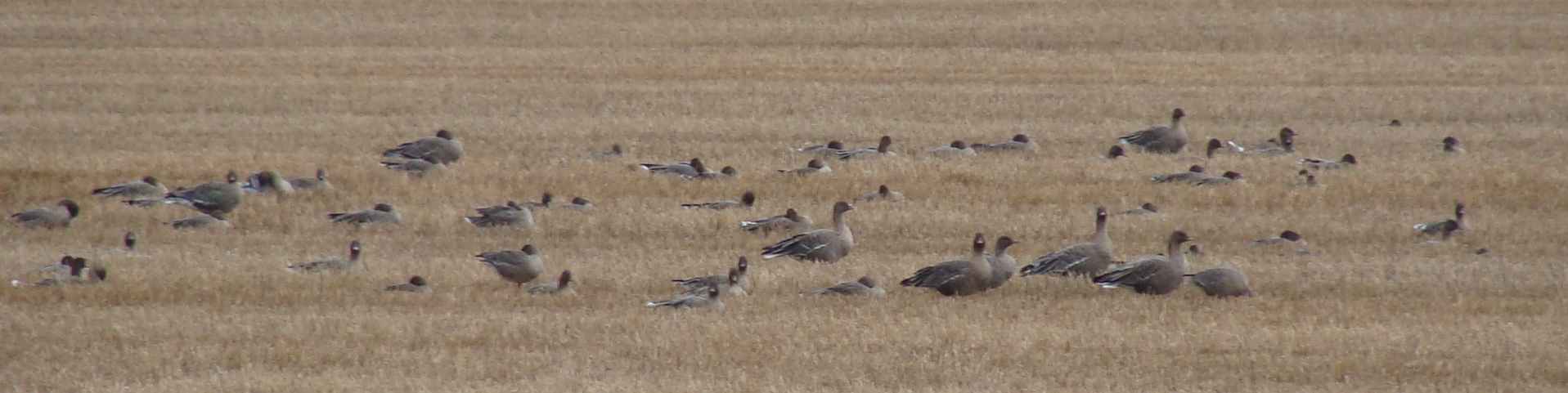
Castle Loch/Hightae Loch
The larger Castle Loch (NY0982), together with Hightae Loch (NY0880) just to the south, comprise a 137 ha Local Nature Reserve, declared in 1962. Castle Loch is also a Ramsar site, SPA and SSSI. Both are sometimes used by considerable numbers of Pink-footed Geese for roosting, particularly in the spring. Both are freshwater lochs with a range of surrounding habitat types, including emergent vegetation, birch and alder carr, areas of acidic, marshy grassland and plantation woodland. Hightae Loch also has more extensive reedbeds.
Pink-footed Geese are rarely recorded using the site before the New Year. Small numbers were present at Castle Loch through the 1960s and 1970s, gradually building to a peak of 16,380 in February 1991 (Fig. 71). At Hightae Loch, records have been very infrequent since 1987/88 (max 4,000 in February 1988 and March 1994). The mean peak winter count (1995/96-1999/2000) for the combined site was just 301.
Most birds feed in the Annan Valley often up to 10 km from the roost. The principal threat to the roost there is general disturbance from human activities. The current management regime appears to be successful in preventing disturbance to the roosting geese, although shooting between September and the end of January may stop birds from settling earlier in the season. The shooting is regulated by a permit system. Fishing has taken place at both Castle Loch and Hightae Loch, although it may have ceased at the latter loch recently.
Waterside Mains
Alongside the River Nith, 20 km upstream of Dumfries, Pink-footed Geese were regularly recorded near Thornhill at Waterside Mains (NX8692) from the late 1960s to the mid 1980s. The flock regularly exceeded 2,000 birds with a peak of 11,950 in March 1984 (Fig. 72).
Minor roosts
Inland from the Solway Firth, occasional flocks are located during WeBS counts and include 112 at Bassenthwaite Lake (NY2128) in January 1981, 180 near Longtown (NY3770) in March 1976, and 140 at Arthuret Pond (NY3767) in February 1982. The River Eden occasionally holds feeding flocks, which presumably roost on the Inner Solway. The floodplain between Crosby and Carlisle (NY4658) held up to 300 in winter 1986/87 and a flock of 3,000 was recorded there in January 1991. Feeding Pink-footed Geese have also been found at Scotby Holmes (NY4357, max 350 in January 1996) and nearby Low Crosby (NY4559) held 250 in November 1992.
Small parties have been recorded at Kirk Loch (NY0783, max 760 in February 1973) and Blind Lochs (NY0683, max 1,000 in October 1994) since 1985/86, and at Cumrue Loch (NY0686, max 650 in March 1992) since 1981/82, suggesting that all three may be infrequently used as a temporary roost when Castle Loch and Hightae Loch are disturbed. Occasional feeding flocks occur inland, and some of these birds may roost on small lochs and flooded fields e.g. Ironhurst Loch (NY0471, max 300 in December 1974) and Chapelcroft (NY0684, max 1,550 in January 1991).
Loch Kindar (NX9664) occasionally holds roosting Pink-footed Geese (max 2,740 in March 1996, although usually fewer than 500) and has done so since the early 1970s, especially in the spring. These are probably birds that have sought refuge from wildfowling disturbance on the coast. Some occasionally move to Loch Arthur, 6 km further inland (NX9068, max 300 in winter 1978/79). Inland roosts may include temporary flooded areas around the Water of Ae (NY0684, 108 in January 1990).
Pink-footed Geese are regularly encountered westwards along the outer parts of the Solway Estuary, for example at Kirkconnel Merse (NX9868, max 1,580 in March 1995) and Mersehead (NX9055). These birds, however, roost and are counted within the Inner Solway Estuary (see 2.1.10). The Lochar Moss (NY0573) is occasionally used as a goose roost, but it has been drastically changed and much reduced in size by forestry. Loch Rutton (NX8972) is occasionally used in the spring, with 850 birds recorded in March 1988, although numbers there are usually much smaller than this. Milton Loch (NX8471) has held Pinkfooted Geese during the spring since the 1970s, with a peak count of 400 in March 1987. The area around Auchrocar (NX0960) held 150 geese in November 1995.
The sandy flats of Auchencairn/Orchardton Bay (NX8151) have held small numbers of Pink-footed Geese on infrequent occasions in the spring since 1987/88, with a peak count of 2,500 at the former site in January 1987 and 1,000 at the latter in March of the same year. Further west, Pink-footed Geese have been occasionally found in the Kirkcudbright and Dee Estuary (NX6849) since 1992, with a peak of 343 in November 1996.
Passage birds are also occasionally encountered at Loch Ken (NX6870), with 192 in November 1980, although most records are from later in the winter, with a peak of 356 in February 1991 (in very recent years occasionally up to 800, P. Collins, pers. comm.) and flocks are becoming more regular. At the southern end of Loch Ken, Pink-footed Geese have been encountered around the Threave Estate (NX7362) since 1990, with a peak of 1,000 in December 1997. Access to the estate is open and the site is occasionally disturbed by the activities of wildfowlers. The geese tend to feed on farmland to the west of Castle Douglas.
Further west, flocks of Pink-footed Geese have, since the early 1990s, become more frequent and a winter tradition is becoming established in the Stranraer area. In February 1990, 2,400 Pink-footed Geese were counted at West Freugh (NX1055), and a flock of 2,000 was there in 1996. At Stranraer, occasional flocks have been recorded roosting with Greylag Geese at Black and White Lochs (NX1060), with 108 in February 1995 and 110 in October 1997. Loch Connell (NX0168) and Cults Loch (NX1260) have also held Pink-footed Geese. More detailed roost counts in this area are recommended as a priority.
For further information on Pink-footed Goose population levels visit the WWT species account pages (Pink-footed Goose)